
How to Choose Between RTK Receivers and Smart Antennas for High-Precision GNSS
How to Choose Between RTK Receivers and Smart Antennas for High-Precision GNSS
When an industrial system needs centimeter-level positioning, hardware decisions often come down to two packaging styles: an RTK receiver that relies on a separate GNSS antenna, and a smart antenna that combines the antenna and receiver in one mechanical housing. Both can sit at the core of a high-precision GNSS solution. The better choice is the one that matches the product's mechanical constraints, antenna placement, RF risks, and long-term supply plan.
This guide is written for procurement teams, system integrators, and engineering managers who have already decided to use RTK technology and now need to decide which form factor to qualify.
Problem Definition
The core positioning engine is usually not the deciding factor. Many of today's modules support the same global constellations and produce RTK fixes at centimeter level. The real challenge is integration. A receiver with an external antenna gives the antenna a clear view of the sky and allows the RF front-end to be placed away from noisy electronics. A smart antenna removes separate antenna procurement and much of the RF layout effort, but it concentrates antenna, receiver, and often inertial sensors into a compact volume.
Buyers at the decision or execution stage therefore need to compare more than positioning accuracy. They need to compare mechanical fit, electrical interfaces, environmental tolerance, interference handling, available heading options, and the supplier's ability to support long-term production.
Industry Background
High-precision GNSS is expanding beyond traditional surveying into UAVs, precision agriculture, autonomous vehicles, robotics, marine navigation, fleet management, and smart port systems. According to Dataintelo, the global high-precision GNSS market was valued at USD 7.8 billion in 2024 and is projected to reach USD 20.6 billion by 2033. The same source reports that agriculture is the dominant application segment, with about 36.8% market share as of 2025.
This wider adoption changes how buyers source high-precision components. A surveying company may have an RF engineer who can tune a receiver board to an external antenna. A robotics OEM may need a drop-in module that can be mounted inside an enclosure without specialized RF engineering. Both are valid; they lead to different hardware selections.
Detailed Solution: What the Product Families Actually Provide
Jumpstar, a Shenzhen-based GNSS manufacturer, supplies both form factors. Its catalog includes RTK modules, GNSS receivers, GNSS antennas, and smart antenna modules. The product family makes it possible to evaluate the same accuracy class in either packaging style. Two representative product families show the difference.
RTK Receivers with Separate Antenna Ports
An RTK receiver is the signal-processing core. It uses RF ports to connect to one or more external antennas. This arrangement is appropriate when the antenna must be mounted on a roof, mast, or other location separated from the processing electronics.

The X43H-AH is a multi-constellation, multi-frequency RTK receiver with dual-antenna heading. It measures 43.8 × 34.0 × 11.5 mm, weighs less than 25 g, and uses 789 hardware channels. Its RTK horizontal accuracy is specified at 0.6 cm + 0.5 ppm, and its heading accuracy is 0.15° at a 1 m baseline or 0.03° at a 5 m baseline. Interfaces include two UARTs, a USB Type-C port, RF1/RF2 antenna ports, and a TF card slot. Power supply is 3.5–12.0 V. The receiver is designed for UAVs, autonomous robots and AGVs, precision agriculture machinery, vehicle-mounted positioning, surveying, and other industrial applications.
The P-Box-X10 is another receiver option for system integrators that need a board-level yet turnkey receiver. It is a multi-constellation triple-frequency receiver with 544 channels, dual RF inputs, Ethernet, three UARTs, USB Type-C, and TF card logging. Its dimensions are 74 × 50 × 12.6 mm and its weight is 67.5 g. P-Box-X10 also includes dual-antenna heading, with specified heading accuracy of 0.15° at a 1 m baseline and 0.03° at a 5 m baseline. It shares the RTK horizontal specification of 0.6 cm + 0.5 ppm.
Smart Antennas with Integrated Front-Ends
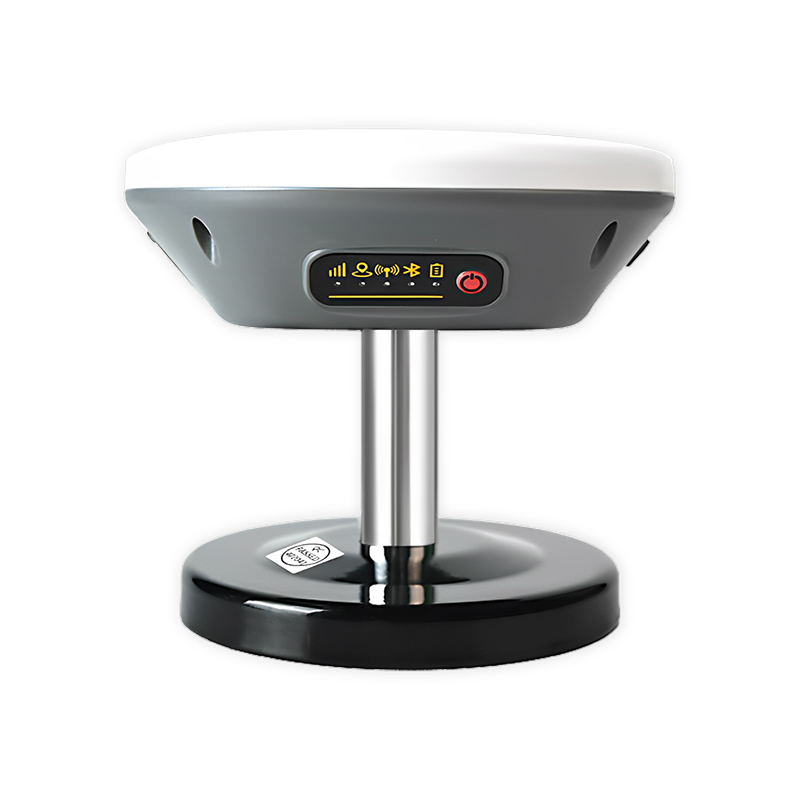
A smart antenna integrates the antenna, active front-end, and positioning receiver into a single housing. For many OEM products, this is the fastest way to add high-precision GNSS because there is no separate patch antenna, cable, or RF connector to qualify.
The JS-SK43H-AH is a multi-band RTK positioning and heading smart antenna module. Its compact package measures 48.0 × 43.2 × 37.0 mm and weighs less than 24 g. It supports 789 channels and achieves RTK horizontal accuracy of 0.6 cm + 0.5 ppm and vertical accuracy of 1 cm + 1 ppm. Heading accuracy is 0.15° at a 1 m baseline and 0.03° at a 5 m baseline. The module includes an active antenna architecture and dual MCX antenna ports, making it suitable for dual-antenna heading in compact unmanned systems. It operates from 4.8 to 5.5 V and is rated for -40°C to +85°C.
The JS-CK43-2 is a related smart antenna module with RTK+INS integration. It combines an integrated active antenna with a multi-band RTK receiver and inertial navigation elements. Its RTK accuracy is specified at horizontal 0.8 cm + 1 ppm and vertical 1.5 cm + 1 ppm. The module can output RTK positioning at up to 50 Hz and IMU data at 100 Hz, with RTK initialization time below 5 seconds for baselines shorter than 10 km.
For applications that need a standalone reference station rather than a module to embed, Jumpstar's JS-X11 is an all-in-one RTK smart antenna/base station. It supports RTK at 2 cm + 1 ppm, includes 4G Cat.1, BLE 5.2, optional radio and Wi-Fi, and has an internal 5200 mAh battery. The enclosure is rated IP66 and measures 122 × 122 × 43.09 mm.
Step-by-Step Breakdown
Use the following process to select between an RTK receiver and a smart antenna.
Step 1: Define the Antenna Location
Start with physical placement. If the antenna will be mounted remotely from the processor, choose an RTK receiver with separate antenna ports. If the entire positioning subsystem must fit inside a small payload or under a plastic radome, a smart antenna module is easier to integrate.
Step 2: Assess RF Interference and Spoofing Risk
Vehicle engines, onboard electronics, and portable jamming devices can produce broadband, narrowband, or pulsed RF noise that degrades GNSS signals. Interference can cause RTK floating solutions or complete loss of satellite lock. In addition, forged GNSS signals can spoof a vehicle's position. If your environment has high interference risk, select hardware with interference suppression and anti-spoofing functions. For example, X43H-AH and P-Box-X10 are specified with AIM+ full-spectrum interference suppression and support for OSNMA anti-spoofing authentication. A smart antenna may be more convenient, but you must verify whether it includes the same protection.
Step 3: Decide Whether You Need Heading
Some industrial platforms need not only position but also heading, pitch, and roll. Both the X43H-AH RTK receiver and the JS-SK43H-AH smart antenna provide dual-antenna heading. If board area is not constrained, a receiver with two antenna ports can be paired with antennas spaced at different baselines. If the platform is compact, a smart antenna with dual MCX antenna ports simplifies the assembly.
Step 4: Check Electrical Interfaces and Update Rate
Review your host system's available interfaces. Many Jumpstar smart antenna modules use UART and I2C pins and require a single 3.3–5.5 V supply. Larger receivers may need 3.5–12 V or 4.5–12 V and provide additional interfaces such as USB, CAN, or Ethernet. Also check the maximum update rate. For fast-moving robots or agricultural machinery, a module with 20 Hz RTK output is commonly available.
Step 5: Compare Environmental and Compliance Requirements
Both RTK receivers and smart antennas in this product family are rated for industrial operating temperatures, with many specified from -40°C to +85°C. Confirm mechanical robustness, humidity rating, and mounting method against the vehicle or equipment profile. Where export to the EU is intended, check RoHS compliance; many Jumpstar modules are documented as RoHS compliant.
Step 6: Validate with a Sample Before Volume Deployment
The final step is a physical test. Jumpstar's procurement support permits sample ordering with one unit as the minimum order quantity and states that 100% of units are tested before shipping. A sample build should confirm satellite acquisition, RTK initialization, heading behavior, and stable communication over the real operational temperature range.
Use Cases
UAVs and Drones
Light UAVs benefit from lower mass and fewer cabling points. A compact smart antenna such as JS-SK43H-AH can provide RTK positioning and heading in a package under 24 g. Larger mapping or delivery platforms may instead use an RTK receiver with external antennas to allow each antenna to be placed for best sky view.
Precision Agriculture
Agriculture has become one of the most important application areas for high-precision GNSS. Tractors, sprayers, and harvesters may need receivers mounted inside a cab, with antennas on the roof. An RTK receiver with external antenna ports gives the installer flexibility to run longer cable lengths and choose a high-stability antenna. For automated implements that are built in a compact enclosure, a smart antenna may be easier to deploy.
Autonomous Vehicles and Robotics
Autonomous ground robots must operate near infrastructure that can create multipath and interference. System integrators often choose dual-antenna receivers such as P-Box-X10 when they need Ethernet logging and dual RF inputs. For small AGVs and inspection robots, the compact smart antenna form factor with integrated INS can reduce assembly complexity.
Surveying and Base Stations
When a project needs a local RTK base station, all-in-one receiver options such as JS-X11 can act as both rover and base. Its IP66 housing, internal battery, and 4G data link make it suitable for field deployment without a separate radio module.
Comparison Table
The table below compares verified specifications from the RTK receiver and smart antenna families.
| Factor | RTK Receiver Example: X43H-AH | Smart Antenna Example: JS-SK43H-AH |
|---|---|---|
| Form factor | Receiver board, 43.8 × 34.0 × 11.5 mm, <25 g; external antenna required | Integrated antenna + receiver module, 48.0 × 43.2 × 37.0 mm, <24 g |
| RTK horizontal accuracy | 0.6 cm + 0.5 ppm | 0.6 cm + 0.5 ppm |
| RTK vertical accuracy | 1 cm + 1 ppm | 1 cm + 1 ppm |
| Heading accuracy | 0.15° at 1 m baseline; 0.03° at 5 m baseline | 0.15° at 1 m baseline; 0.03° at 5 m baseline |
| Antenna architecture | RF1/RF2 antenna ports for external antennas | Integrated active antenna architecture with dual MCX antenna ports |
| Interfaces | 2 × UART, USB Type-C, RF1/RF2, TF card | 8-pin connector including UART/I2C/PPS; dual MCX antenna ports |
| Interference/spoofing protection | AIM+ full-spectrum anti-jamming and OSNMA anti-spoofing support | Not specified in the verified product parameters; verify by model |
| Power | 3.5–12.0 V | 4.8–5.5 V |
| Operating temperature | -40°C to +85°C | -40°C to +85°C |
FAQ
What compliance items should I check before selecting a long-term high-precision GNSS supply partner?
High-precision GNSS buyers should confirm that each module is documented for the target market. Many Jumpstar products are specified as RoHS compliant, and some models, such as the JS-NK43-1 smart antenna, also list CE compliance. The manufacturer serves the EU, Middle East, and USA markets. For a specific model, request the current compliance declaration from the supplier before volume qualifying.
What manufacturing capabilities matter for long-term RTK receiver and smart antenna supply?
Long-term supply decisions should be supported by test and production evidence. Jumpstar's Shenzhen facility covers approximately 5,000 square meters and employs about 200 people, including a 20-engineer R&D team. Its stated annual output is 100,000 units. The company operates an automated SMT assembly line and runs powered burn-in testing on each module. It also maintains an RF anechoic chamber, temperature cycling chamber, and vibration test bench to validate interference, spoofing, and environmental behavior before mass production.
How does form-factor choice affect total project cost?
The full project cost includes antenna procurement, mechanical design, RF cable routing, assembly labor, and field service, not only module price. A smart antenna with integrated antenna can lower integration effort, while an RTK receiver with external antenna may require more RF layout work. In a Jumpstar comparison between turnkey integrated receivers and bare RTK board/module cores, the turnkey receiver was associated with 80% shorter deployment time and 40% lower total project R&D cost for use cases such as port logistics, precision agriculture, and heavy-duty vehicle retrofitting. Exact cost depends on your system architecture.
Can I test both RTK receiver and smart antenna modules before production?
Jumpstar permits evaluation orders with a minimum order quantity of one unit and states that 100% of units are tested before shipping. For high-precision GNSS validation, a sample phase should include satellite acquisition in your real environment, RTK initialization, interference checks, and mechanical fitting. This is also the moment to verify whether a receiver plus external antenna or an integrated smart antenna performs better on your platform.
What lead time and after-sales support can a buyer expect?
For volume production planning, the manufacturer reports a monthly production capacity of 50,000 units and a typical lead time of 30 days. Delivery terms are EXW, and flexible payment terms are available. The company also provides after-sales remote support. These factors are relevant when evaluating long-term supply agreements or scaling from sample to field deployment.
Conclusion and Decision Framework
The decision between RTK receivers and smart antennas is not a decision between accuracy levels; both families can deliver the centimeter-level performance needed for high-precision GNSS solutions. The practical differences are integration effort, antenna flexibility, and risk handling.
Choose an RTK receiver with separate antenna ports when the antenna must be placed away from the processor, when the application needs a large or specialized GNSS antenna, or when the RF environment requires AIM+ anti-jamming or OSNMA anti-spoofing protection. The X43H-AH and P-Box-X10 are representative receiver choices. Choose a smart antenna when mechanical simplicity, low part count, and assembly speed are more important. The JS-SK43H-AH and JS-CK43-2 are representative smart-antenna module choices. If you need a portable base reference, the JS-X11 all-in-one RTK smart antenna/base station offers a field-ready package.
From a supply-chain view, the same manufacturer can support both paths. Jumpstar's in-house production, automated SMT assembly, 100% test-before-shipment policy, and remote after-sales support make it possible to qualify one supplier for both module-level and turnkey hardware.
Next step for procurement teams
Specify your platform's antenna location, RF risk, heading requirement, and volume forecast. Jumpstar can propose the RTK receiver or smart antenna model that fits the project, provide a sample for validation, and share the relevant compliance documentation.
Download the Jumpstar company profile and product overview here: Jumpstar Company Profile 2026 PDF.
For inquiries, contact Alisa at sales@jgnss.com or visit www.jgnss.com.
Have Questions or Need More Details?
Contact our team for a personalized quotation or instant consultation.
Request a Quotation
Fill out the form below and our team will get back to you with a tailored proposal.
WhatsApp Direct Chat
Prefer to chat in real-time? Message us on WhatsApp for instant assistance & quick answers.
- Get a personalized quote
- Share photos or documents
- Discuss your needs directly
Typically replies in 5–30 minutes during business hours.