Understanding Regional GNSS Standards: How Antenna and Receiver Choices Meet Compliance

RF anti-interference testing: the evidence layer behind regional GNSS compliance claims.
Regional GNSS standards influence two decisions that are often made separately: which signals a receiver must process, and how much of the radio-frequency (RF) design stays inside the buyer's own engineering scope. A bare module, a matched antenna and a finished receiver sit at different points on that line, and the point chosen decides who carries the compliance work for a specific market.
This guide is written for importers, integrators and OEM buyers who already know they need centimeter-level positioning and are now placing a specific product into a specific region. It uses the documented product and process facts of Jumpstar — Shenzhen Jumpstar Technology Co., Ltd., a Shenzhen-based GNSS source manufacturer founded in 2013 that produces RTK modules, GNSS antennas and high-precision receivers — as the working example throughout.
In short: regional compliance is decided by three things — the signal set the receiver supports, the interference behaviour of the antenna-plus-receiver chain, and the documentation the supplier can hand over before the goods ship.
Problem Definition: Compliance Is Not Paperwork — It Is Signal Behaviour
Most GNSS programs run into compliance in one of two places, and only one of them is a paperwork problem.
- Market-access failure. The product cannot be placed on the market, or cannot pass a customer's qualification, because the documentation does not match what the region expects — for example, a missing material compliance statement for a module that will ship into the European Union.
- Operational failure. The unit is approved and legal, but it degrades in the field. RTK solutions float, positions drift, or the receiver loses satellite lock because the antenna and receiver were never specified for a dense RF environment. Vehicle engines, onboard electronics and external portable jamming devices generate broadband, narrowband and pulsed RF noise that can obscure satellite signals.
Both failure modes trace back to one decision: how the antenna, the receiver front end and the receiver itself were chosen, and who verified their behaviour as a radio device rather than as a component on a bill of materials.
Industry Background: Who Governs GNSS Signals, and Who Governs GNSS Equipment
GNSS signals are transmitted by government-operated satellite systems — GPS (United States), Galileo (European Union), GLONASS, BeiDou, QZSS and IRNSS. For end users, receiving those signals is generally licence-free. The equipment that receives them, however, is an electronic product placed on a market, and it is regulated as one.
Two regulatory layers apply to that equipment. Material and environmental rules restrict what a product may contain and how it must behave across temperature and vibration; in the European Union, Jumpstar's GNSS modules are documented as RoHS compliant, which is the material compliance requirement the company states for that market. Radio and electromagnetic compatibility rules govern how the finished device behaves as an electrical product in a shared spectrum environment — in the European Union, radio equipment placed on the market must satisfy the applicable radio equipment and EMC requirements, and comparable national authorization regimes exist in other markets. Because those requirements attach to the finished device rather than to a single component, the buyer, the integrator and the module supplier carry different shares of the burden depending on how the product is built.
Application-level standards form a third layer. ISO 12188 parts 1 and 2 define test procedures for positioning and guidance systems in agriculture and forestry, and the Galileo High Accuracy Service is documented as delivering horizontal accuracy down to 20 cm. Neither is a market-access rule, but both shape the performance language that regional buyers, dealers and tenders use.
The commercial context explains the urgency. The global high-precision GNSS market was valued at USD 7.8 billion in 2024 and is projected to reach USD 20.6 billion by 2033 (Dataintelo). The high-precision GNSS module segment was estimated at USD 1.5 billion in 2024 and is forecast to reach USD 4.5 billion by 2035 (Market Research Future). Agriculture was the dominant application segment in 2025 with a 36.8% share, and EUSPA forecasts GNSS downstream revenue of €580 billion by 2034. On the supply side, the mid and high-level precision GPS receiver market is led by Trimble, Hexagon AB, Topcon and Hemisphere GNSS, and Trimble launched the R12i GNSS System in 2024 with integrated IMU technology — a signal that integration, not only signal performance, is where hardware competition is moving.
A Compliance-Ready Architecture: Seven Things to Verify Before an Order
A GNSS design that clears regional requirements usually shows the same characteristics. Each of the following can be verified in a datasheet, a test report or a factory audit before an order is placed.
1. Constellation and band coverage that matches the region
The JS-ARK28-3 high-precision RTK GNSS module supports dual-band, multi-constellation reception — GPS L1/L5, BDS, Galileo, GLONASS, QZSS, IRNSS and SBAS — across 200 tracking channels, with RTK positioning accuracy of 1.0 cm + 1 ppm horizontal and 1.5 cm + 1 ppm vertical (50% CEP, open sky). The JS-AP10-H module covers GPS L1C/A, BDS B1I/B1C, Galileo E1B/C, SBAS L1C/A and QZSS L1C/A. Constellation coverage is a compliance-relevant decision because regional augmentation and authentication services are constellation-specific: a receiver that cannot process the constellation active in the target market also cannot use that region's integrity services.
2. Interference suppression built for dense RF environments
Jumpstar's anti-interference architecture combines AIM+ full-spectrum interference suppression algorithms, built-in automatic wideband noise reduction, triple-channel adaptive narrowband notch filters and APME multipath mitigation. The engineering purpose is specific: filter the electromagnetic interference produced by urban environments and vehicle electronics so that the receiver maintains a fixed RTK solution instead of dropping into float.
3. Anti-spoofing and integrity monitoring
Where navigation data integrity is an acceptance criterion, native support for Galileo OSNMA navigation message anti-spoofing authentication matters, together with built-in RAIM (receiver autonomous integrity monitoring), which identifies and rejects illegal forged satellite signals.
4. Material and environmental compliance with evidence
Jumpstar's GNSS modules are documented as RoHS compliant, meeting the requirements of the EU market. The JS-RK26-U RTK GNSS module is RoHS compliant and is stated as suitable for the EU market; the JS-UK40 module is RoHS compliant; and the 45.0 × 45.0 × 12.7 mm RTK GNSS module carries a RoHS compliance protection level. On the environmental side, hardware intended for vehicle and outdoor duty uses industrial-grade components with an operating range of –40 °C to +85 °C and PCB reinforcement techniques, and the 16.2 × 12.2 × 2.3 mm IMU-integrated module is rated across the same –40 °C to +85 °C window.
5. Documented production evidence
A compliance claim is only as strong as the evidence behind it. Jumpstar maintains an RF interference anechoic chamber, a temperature cycling chamber and a vibration test bench, and completes full validation of anti-interference, anti-spoofing and environmental durability before mass production. Production runs on a fully automated SMT assembly line; every module undergoes a 24-hour power-on burn-in test that verifies positioning accuracy, anti-interference performance and PPS synchronization. Each unit is checked with RxTools software for satellite acquisition, OSNMA enabling or disabling, and anti-interference functionality, and a factory test report is issued for every device.
6. Data handling and traceability
Raw observation data is stored on a TF card in SBF format, which preserves a local record for post-processing and audit. The corresponding risk is that differential data and raw observation trajectories can be intercepted or tampered with during transmission or storage — a consideration that becomes a formal requirement in markets where geographic data handling is reviewed.
7. Continuity of support after installation
Housing, firmware and support policy are all part of long-term compliance. Jumpstar provides companion host computer software for real-time monitoring of interference alarms and positioning integrity status, supports remote deployment of parameter hardening strategies, and offers rapid technical corrective solutions in case of anomalies, with remote after-sales support for units already in the field.
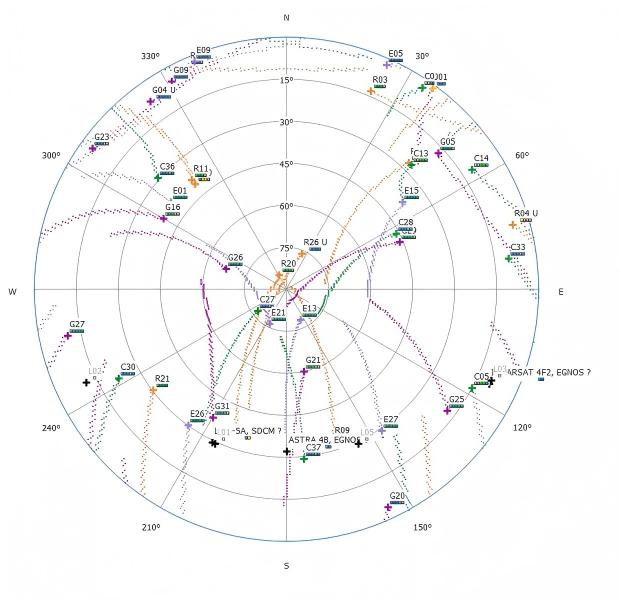
Multi-constellation skyplot: confirming that the constellations used in a target region are actually tracked.
Step-by-Step: A Seven-Step Selection and Compliance Workflow
- Define the market and the RF environment. List every region the product will be sold or operated in, and describe the RF conditions on site — urban multipath, vehicle electronics, industrial equipment. This determines how much interference suppression the antenna and receiver must provide.
- Fix the signal requirement. Select the constellations and bands the target region actually uses, including augmentation and integrity services, then verify them against the module datasheet. The JS-ARK28-3 covers GPS L1/L5, BDS, Galileo, GLONASS, QZSS, IRNSS and SBAS on 200 tracking channels; the JS-A56U9D covers GPS, BDS, GLONASS, Galileo, QZSS and SBAS with 192 search channels and 60 tracking channels.
- Choose the integration level. A bare board, a module inside your own enclosure and a finished receiver are three different compliance positions. Whoever builds the enclosure typically owns the radio and EMC behaviour of the finished device.
- Require interference and spoofing evidence, not adjectives. Ask for the algorithm set — AIM+ full-spectrum suppression, triple-channel adaptive narrowband notch filters, APME multipath mitigation, Galileo OSNMA and RAIM — and for the chamber testing behind it.
- Confirm material and environmental documentation. RoHS statements, operating temperature range and mechanical ratings should arrive before the purchase order, not after. Modules in the range are documented across –40 °C to +85 °C and rated RoHS compliant for EU-facing programs.
- Validate with samples and unit-level reports. Request a sample unit, then confirm that it ships with a factory test report covering satellite acquisition, OSNMA status and anti-interference function.
- Lock the supply path before volume. Confirm capacity, lead time and support before the design freeze. Jumpstar's monthly production capacity is 50,000 units with a typical lead time of 30 days, and remote after-sales support is provided after delivery.
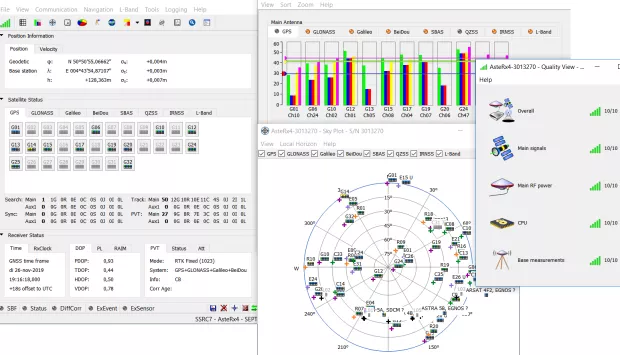
Receiver control software: interference alarms and positioning integrity status in one view.
Use Cases: Where Regional Requirements Change the Product Decision
UAVs, drones and aerial mapping
Airborne platforms are sensitive to weight and to update rate. The JS-ARK37-3 is a high-precision RTK GNSS module rated 3.5 V to 12.0 V (typical 5 V), measuring 36.00 × 36.00 × 9.70 mm ±0.2 mm and weighing under 21 g. Elsewhere in the range, an RTK GNSS module provides a maximum data update rate of 20 Hz and is intended for UAVs and drones, automotive, precision agriculture, marine navigation and similar industries.
Precision agriculture
Agriculture is the largest application segment, holding a 36.8% share in 2025, and the precision farming market is projected to grow from USD 11.38 billion in 2025 to USD 21.45 billion by 2032 (MarketsandMarkets). Regionally, the performance language comes from ISO 12188 parts 1 and 2 and from augmentation services such as Galileo HAS at 20 cm horizontal accuracy. The compliance-relevant specification here is dual-band reception with reliable RTK initialization — for example the dual-band, multi-constellation JS-ARK28-3 at 1.0 cm + 1 ppm horizontal accuracy.
Autonomous vehicles and rail
Vehicle programs add interference, vibration and temperature to the compliance picture. The JS-RK26-U RTK GNSS module with IMU is designed for automotive navigation and rail transit intelligent positioning, with dual-band (L1+L5) GNSS+INS integration, 200 tracking channels, cold start in 28 seconds, speed accuracy of 0.1 m/s CEP and RTK horizontal accuracy of 1.0 cm + 1 ppm in a 16.2 × 12.2 × 2.3 mm footprint weighing under 1.1 g. It supports NMEA 0183 and RTCM3.X and runs at up to 20 Hz across –40 °C to +85 °C.
Automotive navigation and fleet telematics
For telematics and vehicle control, the JS-AP26-H module is designed for automotive applications such as car navigation and vehicle tracking, with tracking and navigation sensitivity of –162 dBm. The JS-TP26-U GPS GNSS module with IMU is used for intelligent driving and vehicle control in automotive navigation, supports GPS, BDS, GLONASS, Galileo, QZSS and SBAS, and provides GNSS+INS positioning accuracy below 1.5 m CEP.
Marine, ports and surveying
Marine and port deployments combine long baselines with reflective surfaces. The 45.0 × 45.0 × 12.7 mm unit is a multi-system, multi-frequency high-precision RTK GNSS receiver with 1408 super channels, RTK horizontal accuracy of 1.5 cm + 1 ppm and vertical accuracy of 2.0 cm + 1 ppm, cold start in under 30 seconds, a 20 Hz maximum update rate, NMEA 0183 and RTCM3.X support, and a –40 °C to +85 °C operating range. RTK GNSS modules in the range are also specified for smart ports, logistics and surveying duty.
Heading and attitude applications
Where orientation matters as much as position — dual-antenna heading, GIS and robotics — the JS-A56U9D supports GPS, BDS, GLONASS, Galileo, QZSS and SBAS with dynamic heading accuracy of 0.3 degrees, velocity accuracy of 0.05 m/s, a velocity limit of 500 m/s and an altitude limit of 80,000 meters, and it supports NMEA 0183 V4.11, V4.0, V4.1, RTCM 3.3 and UBX protocols.
Comparison Table: Who Owns the Compliance Work in Each Procurement Route
The three common procurement routes create three different compliance positions. The notes in the final column are Jumpstar's documented comparison notes against a bare core component.
| Procurement route | Typical reference | Who owns the RF / EMC design | Integration load | Maintenance model | Documented notes |
|---|---|---|---|---|---|
| Bare core component (RTK board or module only) | Beitian UM982-class RTK board / module | The integrator | High — carrier layout, antenna matching, enclosure, EMC | Integrator-maintained | Requires in-house RF engineering capability |
| Module plus matched antenna in the buyer's enclosure | Jumpstar RTK module class, e.g. JS-ARK28-3 or JS-RK26-U | Shared between buyer and supplier | Medium | Field-serviceable by the integrator | Module-level RoHS documentation; –40 °C to +85 °C; 20 Hz update rate; NMEA 0183 and RTCM3.X |
| Turnkey integrated receiver | Jumpstar P-Box class turnkey integrated receiver | Supplier, at unit level | Lower — self-contained unit | Plug-and-play maintenance with remote OTA; no RF engineer required | Up to 80% shorter deployment time and 40% lower total project R&D cost versus a bare core component; comparable power consumption (under 3 W); better anti-interference stability in harsh RF environments |
Comparison based on Jumpstar's documented comparison notes for turnkey integrated receivers versus bare core components.
Regional Verification Checklist
- Material compliance: confirm the RoHS statement that applies to the exact module part number, not to the product family.
- Environmental rating: match the operating temperature range to the deployment site, and check whether vibration testing has been performed.
- Signal set: confirm that the constellations and bands used in the target region are supported, including augmentation and integrity services.
- Interference behaviour: confirm which suppression features are implemented — wideband noise reduction, narrowband notch filtering, multipath mitigation — and on what evidence.
- Anti-spoofing: confirm whether OSNMA authentication and RAIM integrity monitoring are available and how they are enabled.
- Unit-level evidence: confirm that a factory test report accompanies each device, and what it covers.
- Continuity: confirm production capacity, typical lead time, spare-unit policy and remote support terms before design freeze.
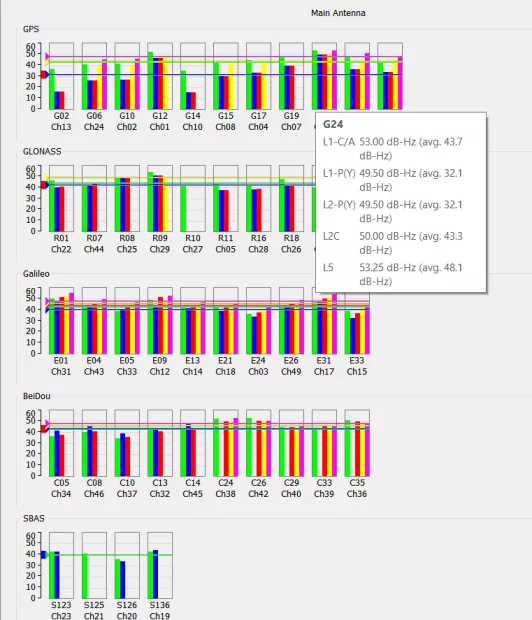
Carrier-to-noise ratio as a signal quality indicator — a practical way to check unit health after delivery.
FAQ
Which compliance documentation covers Jumpstar GNSS modules for the EU market?
Jumpstar's GNSS modules are documented as RoHS compliant, which is the material compliance requirement the company states for the EU market. The JS-RK26-U RTK GNSS Module is RoHS compliant and is stated as suitable for the EU market, the JS-UK40 module is RoHS compliant, and the 45.0 × 45.0 × 12.7 mm RTK GNSS module carries a RoHS compliance protection level. Jumpstar's export markets are the European Union, the Middle East and the USA. Buyers should confirm any additional national equipment approvals their own finished product requires, because those depend on the complete device rather than on the module alone.
How do the modules reduce interference and spoofing risk?
Interference is addressed with AIM+ full-spectrum interference suppression algorithms, built-in automatic wideband noise reduction, triple-channel adaptive narrowband notch filters and APME multipath mitigation technology. Spoofing is addressed through native support for Galileo OSNMA navigation message anti-spoofing authentication and built-in RAIM receiver autonomous integrity monitoring, which identifies and rejects illegal forged satellite signals. Environmental risk is handled with industrial-grade components rated –40 °C to +85 °C, PCB reinforcement techniques and sustained vibration testing, and raw observation data is stored on a TF card in SBF format.
What are the purchase terms and acceptance criteria?
Jumpstar's stated purchase terms are a minimum order quantity of 1 unit, EXW delivery terms, flexible payment terms by T/T, and an acceptance criterion of 100% test before shipping. Buyers who need a documented commercial baseline before a pilot should request the current quotation together with the module datasheet.
Can a unit be validated before a production order is placed?
Yes. A minimum order quantity of 1 unit allows a single sample to be evaluated, and every module passes a 24-hour power-on burn-in test before shipment. Each unit is verified with RxTools software for satellite acquisition, OSNMA enabling or disabling, and anti-interference functionality, and a factory test report is issued for every device. Pre-production validation is also supported by the RF interference anechoic chamber, temperature cycling chamber and vibration test bench used before mass production.
What should buyers check when selecting a long-term high precision GNSS supply partner?
Four items decide whether a partner can support a multi-year program: production capacity, lead time, engineering depth and after-sales reach. Jumpstar operates with a monthly production capacity of 50,000 units and a typical lead time of 30 days, works with an in-house R&D team, supports OEM/ODM customization, and provides remote after-sales support in addition to companion host software for interference and integrity monitoring. The company's export markets are the European Union, the Middle East and the USA, and it operates as a source manufacturer, which keeps datasheets, test reports and design changes traceable over the life of a program. To evaluate the fit for a specific project, request a sample and a quotation from sales@jgnss.com or via WhatsApp at +86 136-2236-7049.

Sample validation and volume production are handled from the same Shenzhen manufacturing base.
Conclusion
Compliance in high-precision GNSS is rarely a single certificate. It is the combined result of the constellations a receiver can use, the interference behaviour of the antenna and front end, the material and environmental documentation that travels with the hardware, and the evidence that every production unit was actually tested. Buyers who treat those four elements as one specification tend to clear market entry earlier and spend less time on field failures.
For long-term programs, the practical test is whether the supplier can keep supplying the same configuration for years: 50,000 units of monthly production capacity, a typical lead time of 30 days, remote after-sales support, and an OEM/ODM path when a design has to be adapted to a new region. Jumpstar supports that model as a source manufacturer rather than a trading intermediary, which is what keeps documentation, test reports and design changes traceable across the life of a program.
Planning a regional GNSS deployment?
Request a sample or a quotation, or download the company profile for full specifications and process documentation. Sample validation starts from a minimum order quantity of 1 unit, with a factory test report issued for every device.
Email: sales@jgnss.com | WhatsApp: +86 136-2236-7049 | Website: www.jgnss.com
Company profile: Jumpstar company profile 2026 (PDF)
Have Questions or Need More Details?
Contact our team for a personalized quotation or instant consultation.
Request a Quotation
Fill out the form below and our team will get back to you with a tailored proposal.
WhatsApp Direct Chat
Prefer to chat in real-time? Message us on WhatsApp for instant assistance & quick answers.
- Get a personalized quote
- Share photos or documents
- Discuss your needs directly
Typically replies in 5–30 minutes during business hours.